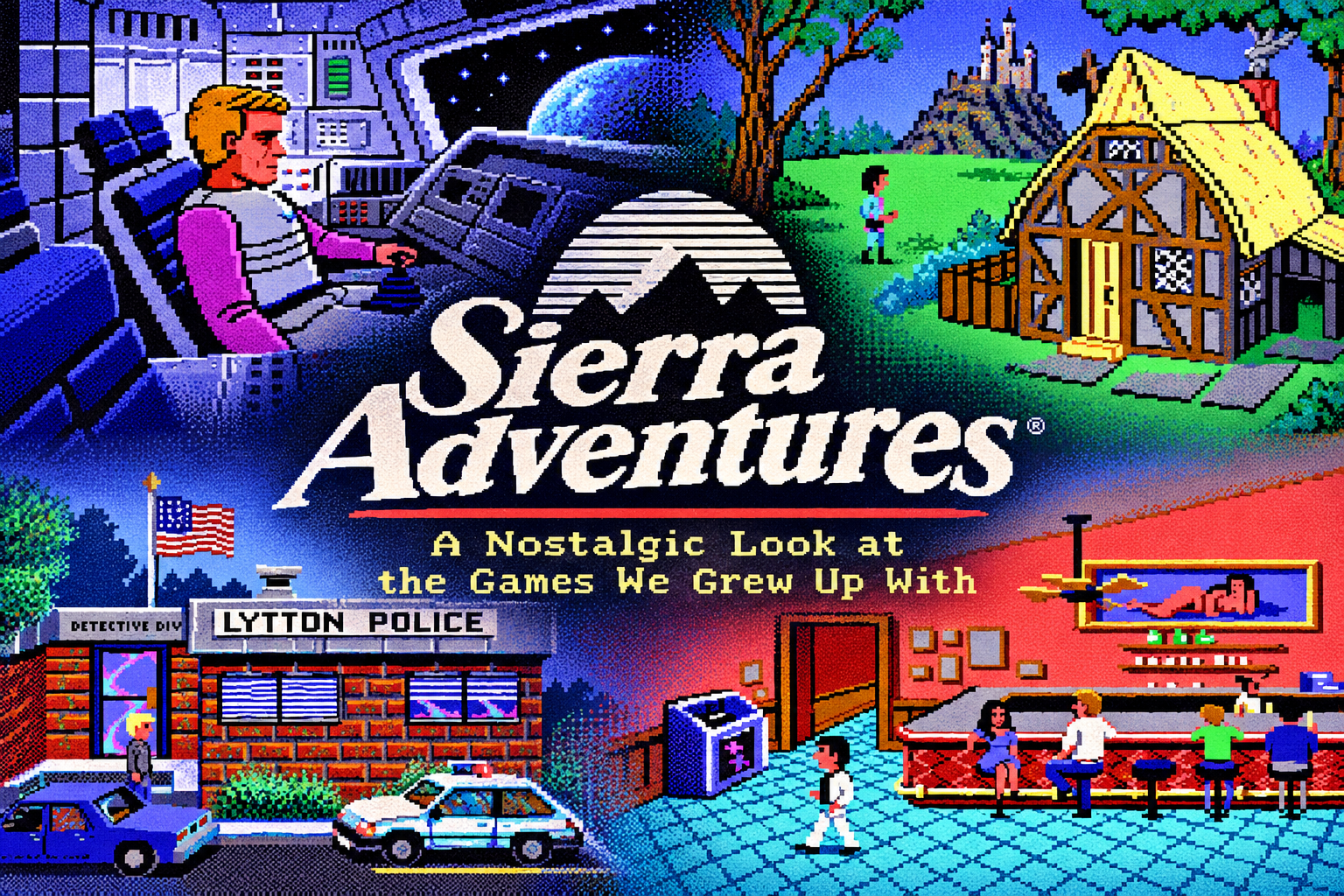
There was a time when computer games were better. This is a well-established fact, supported by countless middle-aged gamers whose memories are completely reliable and in no way influenced by nostalgia, selective recollection, or the fact that they were twelve years old at the time.
I certainly remember it that way.
Growing up with games like King's Quest, Space Quest, Police Quest, and Leisure Suit Larry was something special. Sierra had a remarkable talent for creating worlds that felt enormous, mysterious, and full of possibilities, despite being constructed from approximately seventeen pixels and a colour palette that could comfortably fit on a postage stamp.
And we loved every minute of it.
There was something genuinely magical about exploring those worlds. Every new screen was an adventure, every character potentially important, and every seemingly useless object something you absolutely had to pick up because it might turn out to be essential six hours later. Usually, it did. Occasionally, it didn't, which was arguably worse.
Of course, revisiting these games today reveals certain design decisions that would probably get a modern developer arrested.
Take King's Quest II, for instance. At one point, you encounter a bridge that can only be crossed a limited number of times before it collapses. Seven crossings, to be precise, which happens to be exactly how many you need to complete the game. Cross it unnecessarily early on, perhaps because you fancy a little exploration, and you've effectively made the game impossible to finish. The particularly charming part is that you might not discover your mistake until several hours later, when the bridge finally gives way and takes your hopes and dreams with it.
Sierra apparently believed that curiosity should be encouraged, provided it was accompanied by severe consequences.
And then there were the puzzles.
Some were wonderfully clever, rewarding observation and logical thinking. Others appeared to have been designed by someone who had suffered a minor head injury shortly before lunch.
Take King's Quest V, for example, where the solution to dealing with an enormous, terrifying yeti was to throw a custard pie at it. Not a sword, a magical spell, or some cleverly constructed trap. A pie. One that you'd purchased much earlier in the game and might quite reasonably have eaten, particularly since the game also puts you in a situation where you're starving.
Or consider the original King's Quest, where a gnome asks you to guess his name. The solution involves taking the name Rumpelstiltskin and reversing the alphabet to produce the thoroughly memorable "Ifnkovhgroghprm". Because naturally, when somebody asks you to guess their name, the first thing any sensible person does is reach for a cryptographic substitution cipher.
You could spend three days trying to solve these puzzles, only to discover that the solution required a kind of logic normally associated with people who talk to furniture.
Naturally, we considered this brilliant game design.
But there was another reason we spent so much time with these games, and it's something that's easy to forget today: we simply didn't have that many of them.
Games weren't something you could acquire by clicking a button and waiting thirty seconds. You had to actually go to a shop, browse the shelves, examine the boxes, and decide which game deserved your hard-earned money. There were no Steam sales offering seventeen games for the price of a sandwich, no enormous digital libraries, and certainly no endless stream of free games appearing in your account every week.
Buying a game was an event.
And those boxes! Big, beautiful cardboard boxes with glorious artwork, manuals you could actually read, sometimes maps or other little extras, and a collection of floppy disks that you hoped would all work when you got home. There was something deeply satisfying about putting a new box on the shelf alongside the others, slowly building a physical collection that you could admire even when the computer was switched off.
I miss that. A digital library containing hundreds of games is certainly convenient, but scrolling through a list of titles doesn't quite compare to looking at a shelf full of colourful boxes, each representing an adventure, a memory, and occasionally a rather substantial amount of frustration.
And because getting a new game was relatively rare, you played the ones you had. Thoroughly. You explored every corner, tried every command, and persevered through puzzles that would send a modern player straight to Google within five minutes. Not necessarily because we were more patient or intelligent, but because the alternative was to play something we'd already finished or, heaven forbid, go outside.
Today, we have autosaves, quest markers, helpful hints, and games that generally make a reasonable effort to avoid rendering themselves permanently unwinnable because you forgot to pick up a cheese sandwich in the opening scene. We complain about all this hand-holding, of course, while conveniently forgetting the hours we once spent shouting increasingly creative obscenities at a text parser that refused to understand the word "OPEN".
But perhaps the biggest difference isn't the games themselves.
Back then, we had time, and the games had our undivided attention. An entire afternoon could be devoted to exploring three screens of Space Quest, and getting absolutely nowhere was still considered a productive day. There wasn't an enormous backlog demanding our attention, and we weren't constantly wondering whether we should be playing something else instead.
We weren't necessarily playing better games. We were experiencing them differently.
And that's probably the real trick of nostalgia. It doesn't just remind us of the games we loved. It reminds us of who we were when we played them, when the worlds on our monitors seemed impossibly large, the possibilities even larger, and a new cardboard box on the shelf could promise weeks of adventure.
So were games really better back then?
Some of them, absolutely. Others were terrible, and we'd probably admit it if we were foolish enough to play them again.
But I still love those old Sierra adventures, even if revisiting them occasionally makes me wonder whether their developers actually liked human beings.
Perhaps some games are best left in our memories, where the graphics are sharper, the puzzles make sense, and we always remembered to save before crossing the bridge.